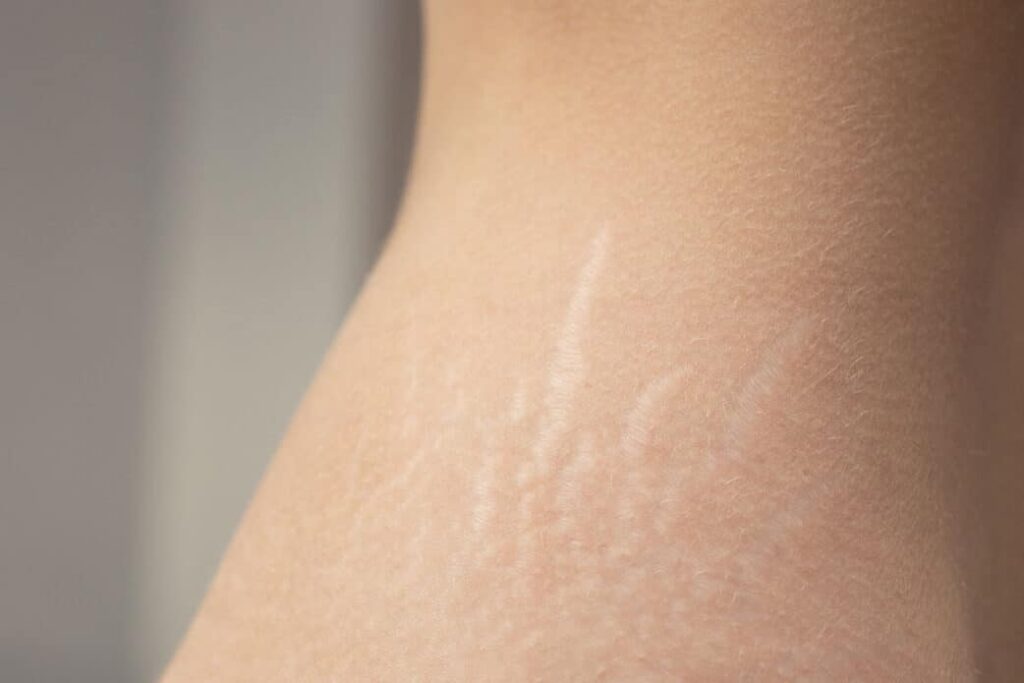
Stretch marks treatment starts with understanding what a stretch mark actually is. Striae are bands of scarred skin that form when the dermis is stretched faster than its collagen and elastin can adapt, through pregnancy, growth spurts, rapid weight change or muscle gain. Fresh marks look pink or purple. Older ones fade to silver white and often sit slightly below the surrounding skin. At North Skin in Mona Vale, Plasma Fibroblast and Plasma Infusion are the treatments used here, matched to how deep the marks actually are. Striae cannot be erased, but their appearance can usually be improved with a considered series.
Why stretch marks form
When skin is pulled quickly, the collagen and elastin network in the dermis tears rather than stretching evenly. The body repairs the gap with scar tissue, which has a different fibre structure to the skin around it. That is why a stretch mark reflects light differently, feels slightly indented and does not tan.
Hormones and genetics play a part too, which is why striae appear through pregnancy and puberty even without dramatic weight change. Red and purple marks are still in an active phase and generally respond better than mature white striae, which are settled scar tissue.
What stretch marks treatment can realistically do
No treatment removes striae. Effective stretch marks treatment works by encouraging the skin to lay down better organised collagen through the scarred band, which helps improve the appearance of depth, texture and colour difference. The mark becomes less obvious rather than absent.
Plasma suits this because it works on the scarred tissue itself. A comparative study of plasma skin regeneration for striae distensae found plasma effective for stretch marks with minimal side effects.
Matching the treatment to the mark
Depth decides the approach, and it is the part most often got wrong.
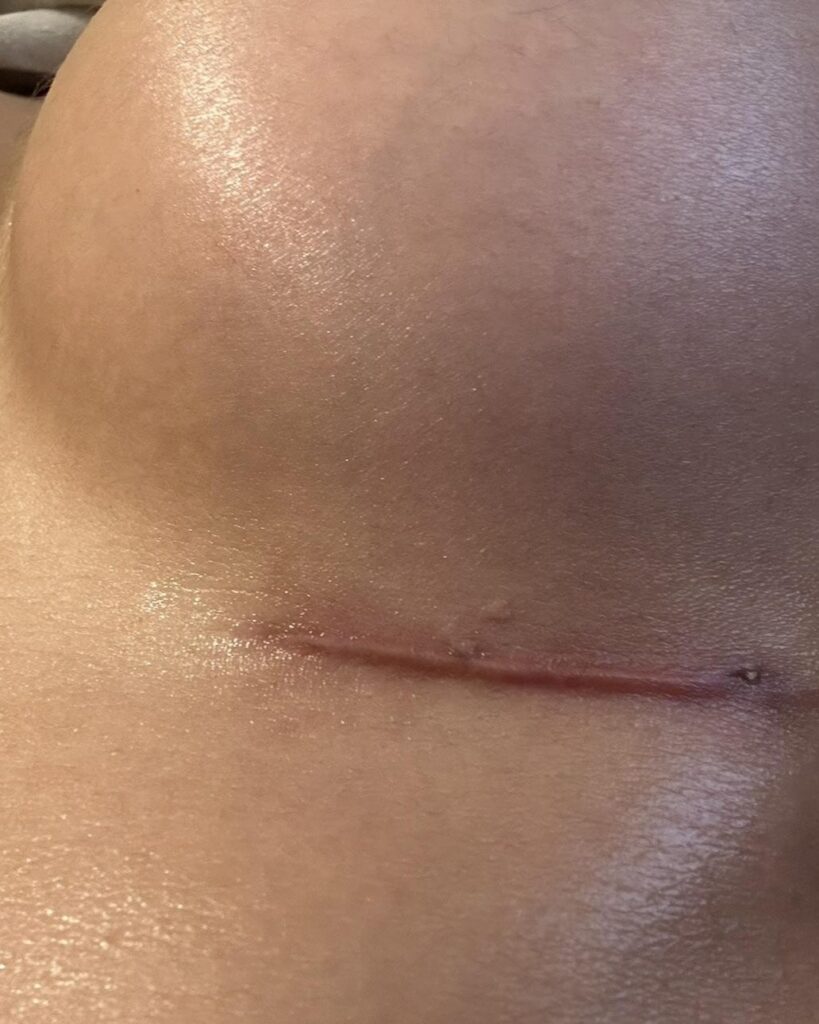
Plasma Fibroblast is the treatment for deeper, indented striae, the ones that feel crater like and sit noticeably below the surrounding skin. Targeted plasma energy is applied into and around the scarred band to tighten the skin surface and soften the drop at the edges, which is where the visible shadow comes from. It is precise, point by point work, and it suits well defined marks rather than a broad field.
Plasma Infusion, most often using the Derma Plasma Roller, is the better choice for smaller, finer and more superficial marks. Plasma assisted microchannelling supports collagen stimulation across the whole band while allowing targeted serum infusion, so it covers ground efficiently where marks are shallow and numerous.
For larger areas where general resurfacing is the goal, Warm Argon Plasma may support the plan, and where nutrition is affecting healing, naturopathy and nutrition can sit alongside it. Most plans use more than one modality, because most people have a mix of deep and fine marks in the same area.
Who it suits and who it does not
This work suits clients who understand they are improving appearance, not erasing marks, and who will commit to a series. Newer marks respond faster, but older white striae can still improve.
Every plan begins with a thorough consultation. Active skin conditions in the area rule treatment out for now. Very dark skin tones require careful assessment before any plasma work because of pigmentation risk. We do not treat suspicious, changing or irregular pigmented lesions unless a dermatologist or skin doctor has assessed them first. We do not treat during pregnancy, and usually wait until breastfeeding and hormone levels have settled.
What to expect
Topical numbing is used where appropriate. For Plasma Fibroblast you may be asked to apply numbing around 40 minutes before you arrive, with an SMS reminder about an hour ahead.
Plasma Fibroblast on a defined mark leaves small carbon dots that lift naturally over roughly days three to seven. Plasma Infusion typically leaves the area red and warm for 24 to 48 hours, with some tightness and mild flaking after. Downtime is set out before you book, because body areas rub against clothing and need more care than the face.
Results and realistic timelines
Stretch marks are a series treatment, not a one off. Most plans run three to six sessions spaced four to six weeks apart, and the skin keeps remodelling for months afterwards. Suitable clients may notice softer texture and reduced colour contrast from weeks six to twelve.
Results vary with the age of the marks, their depth, skin type, healing response and aftercare. Progress photos are taken so you can see the actual change. More detail sits on our scar treatment page.
Stretch marks treatment FAQs
No. Stretch marks are scar tissue, and no treatment removes them entirely. What good stretch marks treatment does is encourage better organised collagen through the scarred band, which helps improve the appearance of depth, texture and colour difference so the marks become far less noticeable. Results vary.
They can, but more slowly than red or purple ones. Fresh marks are still in an active phase with good blood supply, so they remodel faster. Mature white striae are settled scar tissue and usually need a longer series. Improvement tends to show in texture and surface quality first.
Plasma Fibroblast is what we reach for when striae are deep and crater like. Targeted plasma energy tightens the skin surface and softens the drop at the edges of the scarred band, which is what creates the visible shadow. Finer, more superficial marks are usually better suited to Plasma Infusion.
Most plans run three to six sessions spaced four to six weeks apart. Deeper or older striae, and larger areas such as the abdomen or thighs, often sit at the higher end of that range. Your practitioner maps a realistic series at consultation rather than committing you to a set number upfront.
We do not treat stretch marks during pregnancy. After birth we usually wait until breastfeeding has finished and hormones have settled, because the skin is still changing and healing responses are less predictable. Marks that are still red may keep fading on their own.
Stretch marks are extremely common and nothing to feel awkward about. A consultation will tell you quickly which approach suits your particular marks. Consultations happen in our private studio in the heart of Mona Vale, and you are welcome to book a time to talk it through.
Related reading: Uneven Skin Texture: What Causes It and How to Improve It and Plasma Fibroblast for Crepey Skin.